





Artificial intelligence–supported deep learning approaches for enhancing mathematical literacy in elementary teacher education
Abstract
Keywords
Full Text:
PDFReferences
Alhebaishi, S., Stone, R., & Ameen, M. (2025). Emotional Engagement and Teaching Innovations for Deep Learning and Retention in Education: A Literature Review. International Journal of Advanced Computer Science and Applications, 16(3). https://doi.org/10.14569/IJACSA.2025.0160304
Ali, H., & Hashmi, Dr. M. A. (2025). The Impact of Active Learning on Performance of University Students. ACADEMIA International Journal for Social Sciences, 4(3), 3151–3164. https://doi.org/10.63056/ACAD.004.03.0600
Bai, Y., & Wang, S. (2025). Impact of generative AI interaction and output quality on university students’ learning outcomes: a technology-mediated and motivation-driven approach. Scientific Reports, 15(1), 24054. https://doi.org/10.1038/s41598-025-08697-6
Bereczki, E. O., & Kárpáti, A. (2021). Technology-enhanced creativity: A multiple case study of digital technology-integration expert teachers’ beliefs and practices. Thinking Skills and Creativity, 39, 100791. https://doi.org/10.1016/j.tsc.2021.100791
Ricita, D. A., Halim, A., & Sunarti, S. (2025). Exploring Teachers’ and Students’ Perceptions of Deep Learning: Integrating Meaningful, Mindful, and Joyful Learning in ELT Classrooms. Borneo Educational Journal (Borju), 7(2), 323–347. https://doi.org/10.24903/bej.v7i2.2078
Diputera, A. M. (2024). Memahami Konsep Pendekatan Deep Learning dalam Pembelajaran Anak Usia Memahami Konsep Pendekatan Deep Learning dalam Pembelajaran Anak Usia Dini Yang Meaningful , Mindful dan Joyful : Kajian Melalui Filsafat Pendidikan. (December). https://doi.org/10.24114/jbrue.v10i2.67168
Huang, J. (2022). The Role of English as a Foreign Language Teachers’ Mindfulness and Compassion in Fostering Students’ Foreign Language Enjoyment. Frontiers in Psychology, 13(May). https://doi.org/10.3389/fpsyg.2022.899298
Jupriyanto, Prasetyo, Z. K., Sujarwo, Kusmaryono, I., & Sari, Y. (2025). Implementation of cyberlearning in elementary schools: case study in Indonesia. Journal of Education and Learning, 19(3), 1698–1705. https://doi.org/10.11591/edulearn.v19i3.22442
Kurniawan, D., Masitoh, S., Bachri, B. S., Warman, Kamila, V. Z., Subastian, E., Sulfa, & Wahyuningsih, T. (2025). Integrating AI in digital project-based blended learning to enhance critical thinking and problem-solving skills. Multidisciplinary Science Journal, 7(12), 2025552. https://doi.org/10.31893/multiscience.2025552
Kurniawati, H., Widiasari, E., Zalafi, Z., Putri, S. A., Hidayah, K., & A’yun, N. Q. (2023). Career Intervention to Enhance Students’ Career Maturity. International Journal of Multidisciplinary Research and Analysis, 06(04). https://doi.org/10.47191/ijmra/v6-i4-55
Lestari, W., Suweken, G., & Sariyasa, S. (2025). Harnessing AI-Powered Learning Media in Mathematics Education: A Systematic Review on Improving Students’ Problem-Solving Skills. International Journal of Education, Management, and Technology, 3(3), 925–945. https://doi.org/10.58578/ijemt.v3i3.7922
Malik, M. Abd., & B, M. (2025). Analysis of Students’ Mathematical Literacy Ability in Solving Contextual Problems in Linear Equations. Journal of Educational Analytics, 4(3), 647–662. https://doi.org/10.55927/jeda.v4i3.364
Megawati, L. A., & Sutarto, H. (2021). Analysis Numeracy Literacy Skills in Terms of Standardized Math Problem on a Minimum Competency Assessment. Unnes Journal of Mathematics Education, 10(2), 155–165. https://doi.org/10.15294/ujme.v10i2.49540
Diponegoro, M. A., Kusumawardani, S. S., & Hidayah, I. (2021). Tinjauan Pustaka Sistematis: Implementasi Metode Deep Learning pada Prediksi Kinerja Murid. Jurnal Nasional Teknik Elektro Dan Teknologi Informasi, 10(2), 131–138. https://doi.org/10.22146/jnteti.v10i2.1417
Nizaruddin, & Kusmaryono, I. (2023). International Journal of Educational Methodology Transforming Students ’ Pseudo -Thinking Into Real Thinking in Mathematical Problem Solving. International Journal of Educational Methodology, 9(3), 477–491. https://doi.org/10.12973/ijem.9.3.477
Novita, R., Herman, T., Suryadi, D., Dasari, D., & Putra, M. (2022). How Pre-Service Elementary Teachers Deal with Mathematical Literacy Problems? A Case Study. https://doi.org/10.2991/assehr.k.211229.022
Nurhakiki, J., Yahfizham, Y., William, J., Ps, I. V, Estate, M., Percut, K., Tuan, S., & Serdang, K. D. (2024). Studi Kepustakaan: Pengenalan 4 Algoritma Pada Pembelajaran Deep Learning Beserta Implikasinya. Jurnal Pendidikan Berkarakter, (1), 270–281. https://doi.org/10.51903/pendekar.v2i1.598
Özer, M. (2020). What Does PISA Tell Us About Performance of Education Systems? Bartın University Journal of Faculty of Education, 9(2), 217–228. https://doi.org/10.14686/buefad.697153
Kusumadewi, R. F., Ulia, N, Wijayanti, A. C. N., Yunita Sari, M. A. (2025). Assistance in The Use of Traditional Games to Improve Numeracy Literacy SDN Karangroto 03. 593–600. https://doi.org/10.20961/shes.v6i3.82332
Saputra, S. A., Siswanto, D. H., & Suryatama, H. (2025). The Urgent Need for Mathematics Learning Innovation in the Era of Society 5.0. Academicus: Journal of Teaching and Learning, 4(2), 71–81. https://doi.org/10.59373/academicus.v4i2.82
Su, T., & Bei, S. (2025). Research on the Practical Teaching Reform of “Deep Learning and Applications” Course Supported by Generative AI Technology. Journal of Educational Theory and Practice, 2(4). https://doi.org/10.62177/jetp.v2i4.837
Ustun, A. B., Zhang, K., Karaoğlan-Yilmaz, F. G., & Yilmaz, R. (2023). Learning analytics based feedback and recommendations in flipped classrooms: an experimental study in higher education. Journal of Research on Technology in Education, 55(5), 841–857. https://doi.org/10.1080/15391523.2022.2040401
Vale, I., & Barbosa, A. (2023). Active learning strategies for an effective mathematics teaching and learning. European Journal of Science and Mathematics Education, 11(3), 573–588. https://doi.org/10.30935/scimath/13135
Wahyuni, A., Muhaimin, L. H., Hendriyanto, A., & Tririnika, Y. (2024). Exploring Middle School Students’ Challenges in Mathematical Literacy: A Study on AKM Problem-Solving. AL-ISHLAH: Jurnal Pendidikan, 16(3), 3335–3349. https://doi.org/10.35445/alishlah.v16i3.5729
Zhai, Y., Chu, L., Liu, Y., Wang, D., & Wu, Y. (2024). Using deep learning-based artificial intelligence electronic images in improving middle school teachers’ literacy. PeerJ Computer Science, 10, e1844. https://doi.org/10.7717/peerj-cs.1844
DOI: http://dx.doi.org/10.30659/pendas.13.1.23-36
Refbacks
- There are currently no refbacks.
Copyright (c) 2026 Jurnal Ilmiah Pendidikan Dasar

This work is licensed under a Creative Commons - Attribution-NonCommercial-ShareAlike 4.0 International License.
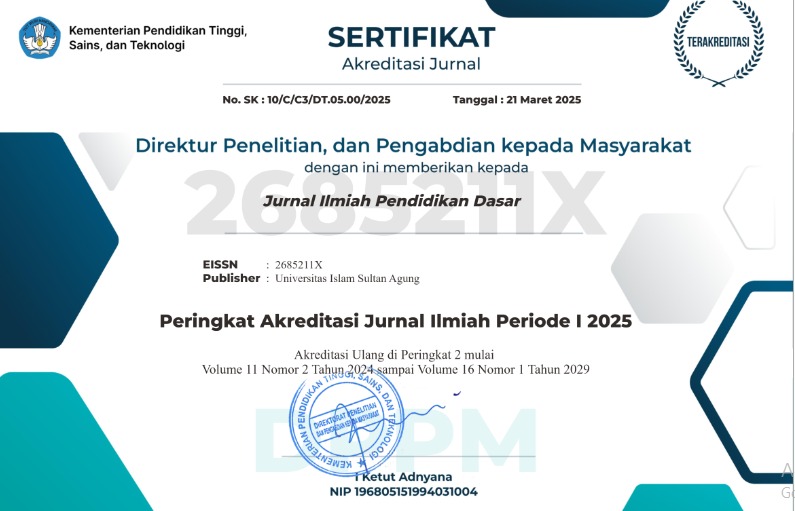
Jurnal Ilmiah Pendidikan Dasar is published by Elementary School Teacher Education (PGSD), Faculty of Teacher Training and Education (FKIP), Universitas Islam Sultan Agung, in collaboration with Asosiasi Doktor Pendidikan Dasar Indonesia.
Contact us: FKIP Unissula Jl. Raya Kaligawe Km.4 Terboyo Kulon, Genuk, Semarang 50112. Email: jurnalpendas@unissula.ac.id