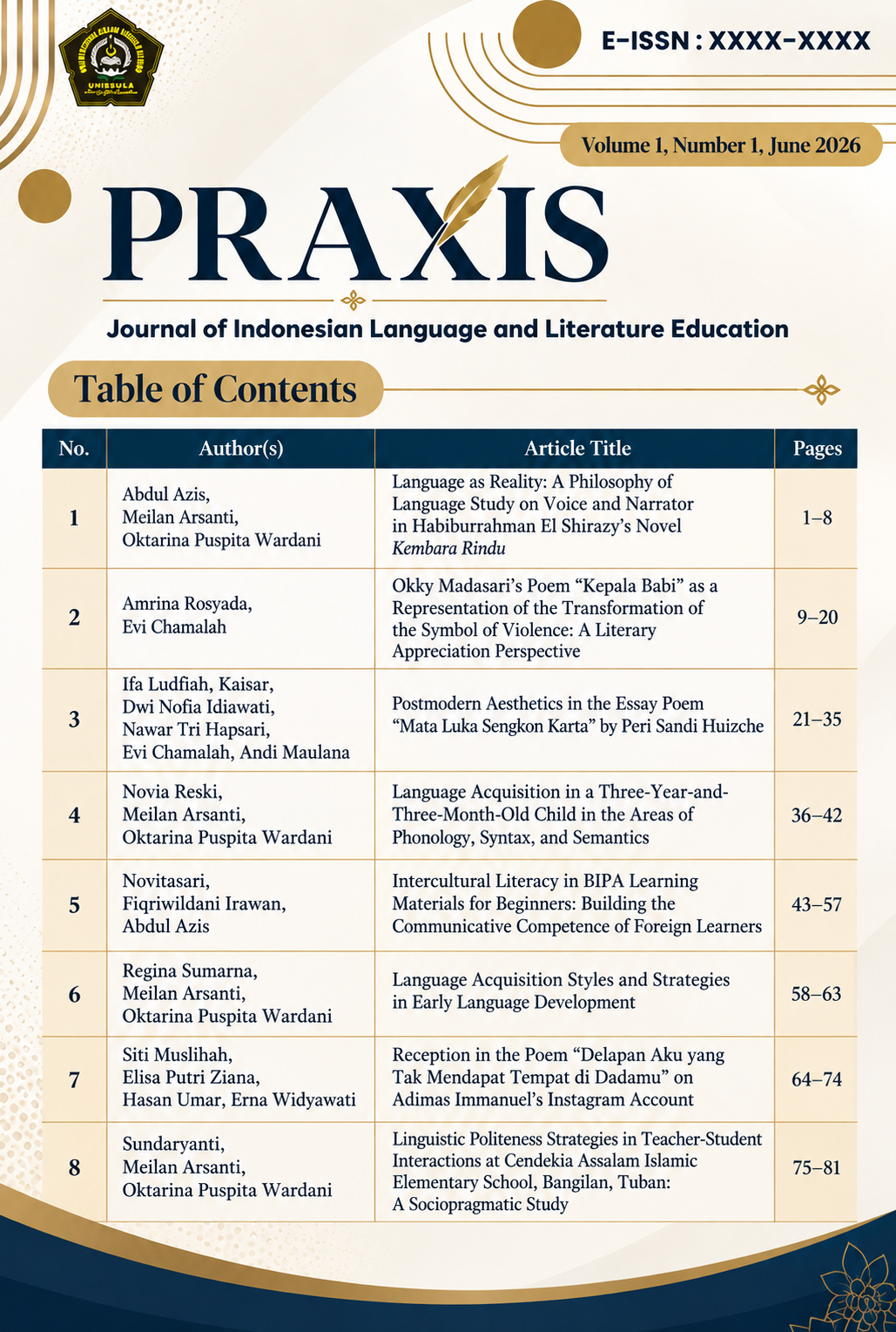
Language acquisition in a three-year-and-three-month-old child in the areas of phonology, syntax, and semantics
Abstract
This study examines language acquisition in a 3-year-3-month-old child across three main linguistic dimensions: phonology, syntax, and semantics. Employing a case study approach supported by a literature review, this research analyzes spontaneous utterances in various daily interaction contexts. Data were collected through naturalistic observation and transcription of child speech during play, storytelling, and parent-child conversations. The results indicate that phonologically, the child has acquired most Indonesian phonemes, though phonological processes such as substitution and deletion still occur. Syntactically, the child constructs simple to compound sentences using coordinative conjunctions. Semantically, vocabulary is expanding rapidly, encompassing nouns, verbs, adjectives, and basic semantic relations. These findings support the interactionist perspective, emphasizing the role of environmental input and innate cognitive capacity in child language acquisition.
Keywords: language acquisition, phonology, syntax, semantics, early childhood, case study