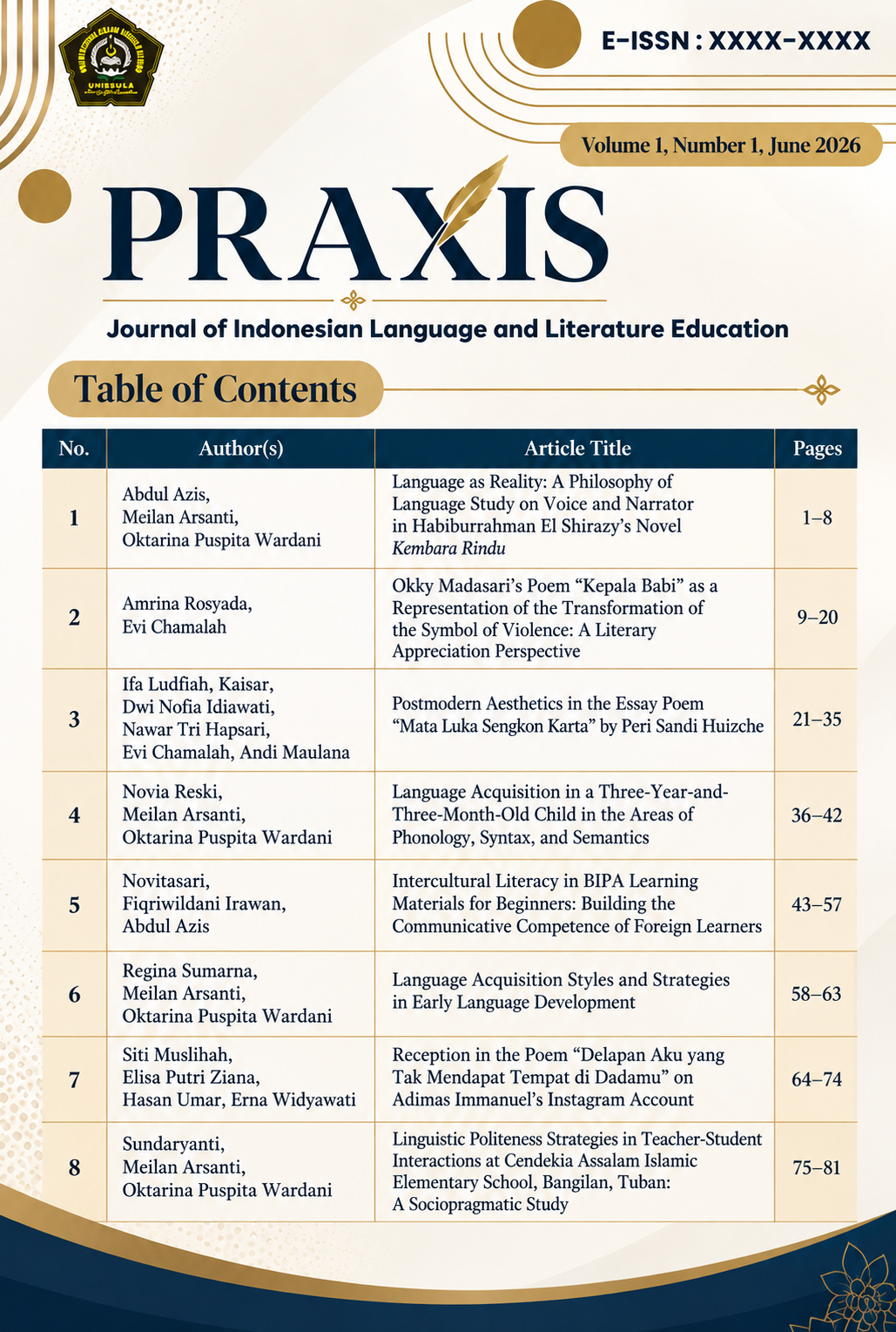
Linguistic Politeness Strategies in Teacher-Student Interactions at Cendekia Assalam Islamic Elementary School, Bangilan, Tuban: A Sociopragmatic Study
Abstract
This study examines linguistic politeness strategies in teacher-student interactions at Cendekia Assalam Islamic Elementary School, employing a descriptive qualitative approach with a sociopragmatic perspective. The theoretical framework is based on Brown and Levinson’s (1987) politeness theory and Leech’s (1993) politeness principles. Data were collected through observation, recording, transcription, and in-depth interviews, yielding 352 utterances that were subsequently analyzed using the interactive analysis model proposed by Miles, Huberman, and Saldana (2014). The results reveal four politeness strategies employed by teachers: positive politeness (36%), bald-on-record (32%), negative politeness (22%), and off-record (10%). Positive politeness strategies predominate as teachers consciously build emotional rapport through praise, friendly forms of address, and expressions of empathy to foster student motivation and self-confidence. The choice of strategy is influenced by three primary factors: situational context, student characteristics, and pedagogical goals. This study reinforces the relevance of Brown and Levinson’s theory and Leech’s principles within the Indonesian primary education context and demonstrates that politeness strategies are dynamic and contextual. These findings have practical implications for enhancing teacher communication competence—through Teacher Professional Education (PPG) programs or in-service training—aimed at creating humanistic and inclusive learning interactions.
Keywords: linguistic politeness, speech strategies, teacher-student interaction, sociopragmatics, primary education