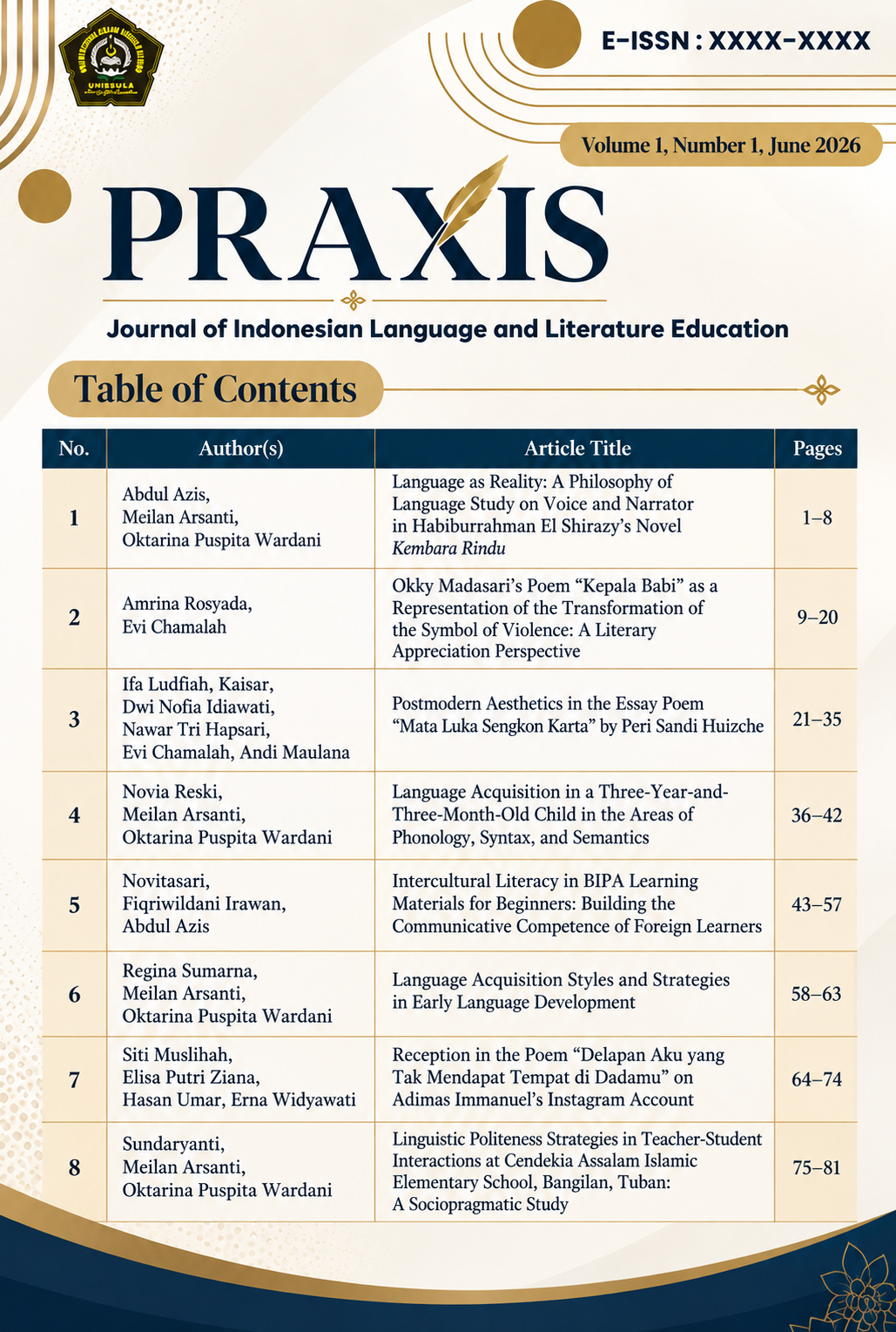
Language as reality: A philosophy of language study on voice and narrator in Habiburrahman El Shirazy's novel Kembara Rindu
Abstract
This study aims to uncover how language shapes and constructs existential, religious, and social realities in the novel Kembara Rindu by Habiburrahman El Shirazy through the lens of the philosophy of language. The primary focus of the inquiry is directed toward the dynamics of "voice" and the position of the "narrator" as discursive agents who do not merely report the story, but actively produce ontological truth for the characters. The method employed is a descriptive qualitative approach utilizing Hans-Georg Gadamer's philosophical hermeneutics alongside Ludwig Wittgenstein's and J.L. Austin's speech act theories. The data source comprises a textual corpus containing existential narratives and theological dialogues within the novel. The findings reveal two primary conclusions: first, the narrator acts as a transcendental entity that directs language not as a mirror of reality (picture theory), but as a space for the creation of reality itself (language games); second, the characters' "voices" mutate from mere communication tools into performative acts that construct religious consciousness and resolve spiritual conflicts. The conclusion of this research affirms that in religious literature, language is reality itself a space where the sacred and the profane are discursively negotiated.
Keywords: Philosophy of Language, Voice, Narrator, Kembara Rindu, Discursive Reality.