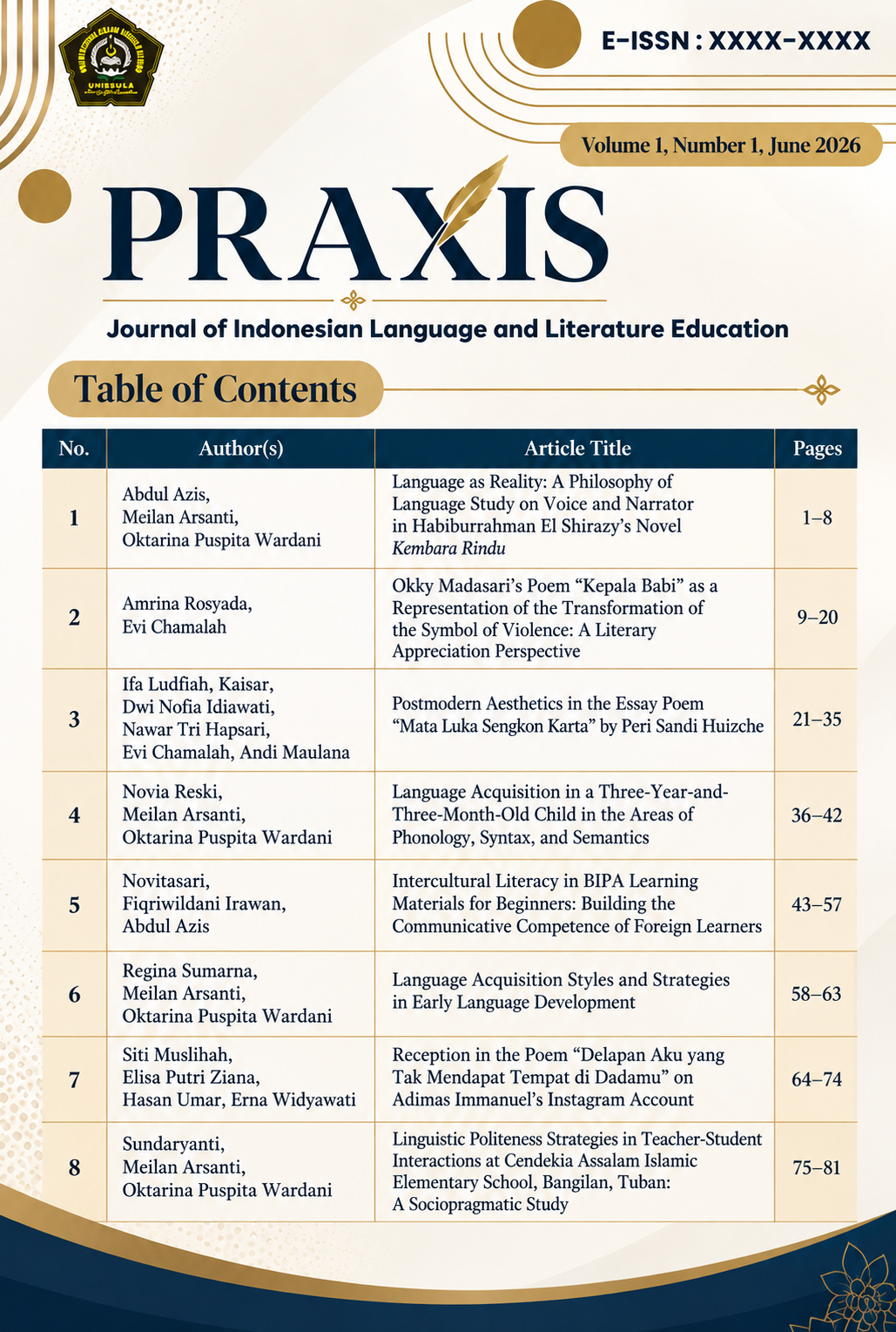
Language Acquisition Styles and Strategies inEarly Language Development
Abstract
Child language acquisition is a natural process that begins in early childhood through social interaction and environmental exposure. This study aims to describe children’s language acquisition styles and strategies, and to identify the factors influencing early language development. Using a qualitative approach with a literature review method, data were collected from books, journal articles, and scientific studies related to child language acquisition. The data analysis employed descriptive qualitative techniques, including data reduction, data presentation, and conclusion drawing. The findings indicate that child language acquisition is influenced by four main factors: biological factors, social environment, intelligence, and motivation. The study also identifies several language acquisition styles, namely field independence, left and right brain dominance, tolerance of ambiguity, reflectivity and impulsivity, and visual, auditory, and kinesthetic learning styles. Furthermore, children use two primary language acquisition strategies: avoidance strategies and compensatory strategies. The development of language progresses through several stages, from the pre-linguistic stage to the one-word, two-word, and multi-word stages.The study concludes that a supportive social environment and the use of appropriate communication strategies play a crucial role in the success of early language acquisition. Therefore, understanding children’s acquisition styles and strategies is essential for parents and educators to facilitate effective language learning in early childhood.
Keywords: language acquisition, child language development, language strategies, learning styles, early childhood