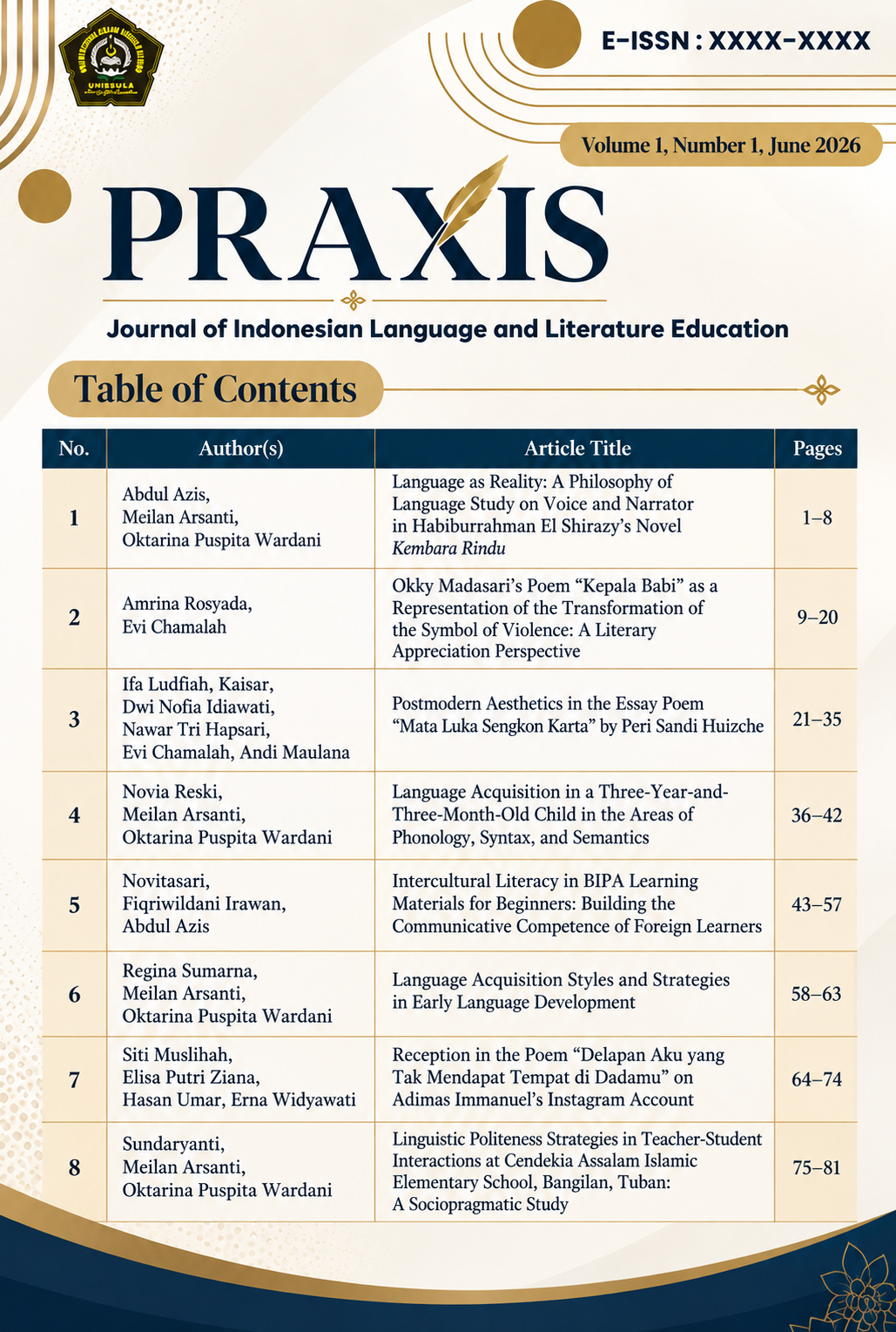
Okky Madasari’s Poem “Kepala Babi” as a Representation of the Transformation of the Symbol of Violence: A Literary Appreciation Perspective
Abstrak
In sociopolitical dynamics, a gap often exists between the theory and practice of enforcing power; while theoretically, rulers project absolute dominance, in practice, they frequently rely on symbolic intimidation to silence public critical reasoning. This study aims to describe the structural integrity of the physical and inner aspects of the poem "Kepala Babi" (The Pig’s Head) and to dismantle the semiotic mechanisms behind reversing the meaning of terror objects into instruments of subversive resistance. The method employed in this study is qualitative-descriptive, utilizing content analysis dissected through the lenses of structural poetry theory and cultural semiotics. The main findings indicate that the poem "Kepala Babi" possesses solid structural integrity, wherein vulgair-macabre physical elements organically integrate to convey the poem's defiant and cynical inner layers. Furthermore, the study uncovers a radical mechanism of deconstruction and re-coding of violence symbols, where material objects of intimidation, such as the pig's head and rat carcasses, are successfully reclaimed by the public and transmuted into back-aggression energy through culinary metaphors (rica pedas perlawanan) and metaphysical psychological warfare (teluh). In conclusion, this study asserts that the poem successfully represents the radical transition of grassroots society from passive recipients of violence to active counter-attackers; proving that the effectiveness of state terror automatically blunts and recoils to destroy the rulers' own psychological stability once the public possesses the cultural courage to invert the logic of intimidation.
Referensi
Damono,S.D. (2020). Sociology of Literature: A Brief Introduction. Gramedia Pustaka Utama.
Endraswara, S. (2013). Literary Research Methodology: Epistemology, Models, Theories, and Applications. CAPS.
Faruk. (2017). Grassroots Literature and the Symbolic Deconstruction of Power. Jurnal Poetika, 5(2), 89–101.
Fransori, A. (2017). A Stylistic Analysis of Chairil Anwar’s Poem “To the Beggars.” Deiksis, 9(1), 1–12.
Gerung, J., Meruntu, O. S., & Senduk, T. (n.d.). Representations of student resistance in the lyrics of the songs “Darah Juang” and “Pembebasan” (A Semiotic Analysis Based on Charles Sanders Peirce) [Unpublished thesis/paper]. Department of English Language and Literature Education, Manado State University.
Haryatmoko. (2016). Uncovering the mechanisms of symbolic violence by those in power through critical discourse analysis. Jurnal Basis, 65(3), 12–25.
Hoed, B. H. (2014). Semiotics and sociocultural dynamics. Komunitas Bambu.
Krippendorff, K. (2018). Content analysis: An introduction to its methodology (4th ed.). Sage Publications.
Miles, M. B., Huberman, A. M., & Saldaña, J. (2019). Qualitative data analysis: A methods sourcebook (4th ed.). Sage Publications.
Pradopo, R. D. (2014). The study of poetry: Analysis of normative strata and structural and semiotic analysis. Gadjah Mada University Press.
Ratna, N. K. (2019). The Aesthetics of Literature and Culture. Pustaka Pelajar.
Santoso, P. (2021). The Alchemy of Language: Transforming the Trauma of Intimidation into Literary Aggression. Litera: Journal of Language and Literature Research, 20(3), 204–218.
Sobur, A. (2016). Semiotics of Communication. Remaja Rosdakarya.
Sugiyono. (2021). Quantitative, Qualitative, and R&D Research Methods. Alfabeta.
Tjahjono, T. (2025). Fighting Power with Poetry [Manuscript/Paper]. Department of Indonesian Language and Literature, Surabaya State University.
Yusuf, M. M., & Farhan, M. (2022). Analysis of Language Errors in the Online News Article “The Meaning Behind the Keris Is Not Merely About the Mystical” on Kompas.com. Populer: Student Research Journal, 1(4), 115–122.