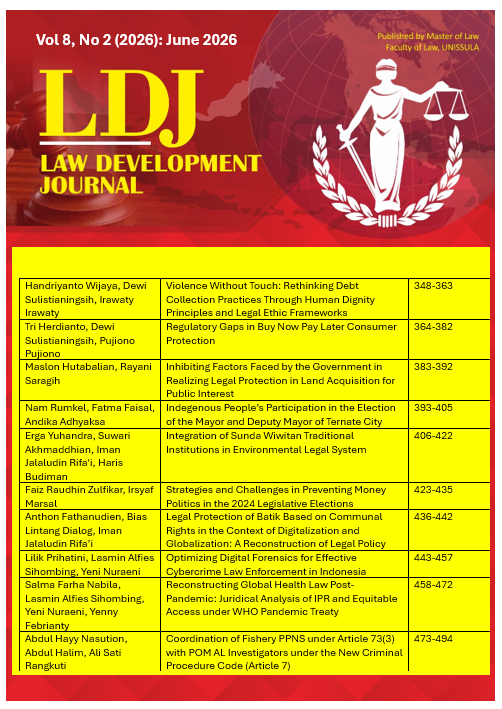
Violence Without Touch: Rethinking Debt Collection Practices Through Human Dignity Principles and Legal Ethic Frameworks
DOI:
https://doi.org/10.30659/ldj.8.2.348-363Keywords:
Collection, Dignity, Financial, Technology.Abstract
The rapid expansion of financial technology lending services in Indonesia has significantly transformed debt collection practices from conventional direct collection methods into indirect forms of coercion conducted through digital communication and social pressure. In practice, debt collection activities increasingly involve persistent intimidation, threatening communications, and the misuse of personal data, often affecting individuals within the debtor’s social sphere. Consequently, private financial obligations are exposed to broader public scrutiny, resulting in psychological distress, reputational damage, fear, and social exclusion. This research examines such practices as a form of non-physical coercion operating through psychological and social mechanisms. This study employs a normative legal research method through the examination of Indonesian statutory regulations, regulatory frameworks, and relevant legal doctrines concerning debt collection practices and personal data protection. The findings demonstrate that coercive non-physical debt collection practices have become increasingly prevalent within digital lending systems, particularly through the dissemination and exploitation of personal data as a means of exerting social pressure upon debtors. Furthermore, the involvement of third parties intensifies coercive circumstances and increases the potential violation of human dignity and privacy rights. Nevertheless, the existing legal framework remains fragmented, compliance-oriented, and inadequate to effectively address the substantive harms arising from such practices. Accordingly, this research proposes a dignity-based legal assessment framework emphasizing proportionality, personal data protection, accountability, and humane standards of debt collection in order to promote fair, lawful, and responsible financial technology practices.
References
Journals:
Ahmad Redi. “Legal Problems in Peer-to-Peer Lending in Indonesia.” Jurnal Pembaharuan Hukum 10, no. 1 (2023): 1–15.
Arner, Douglas W., Janos Barberis, and Ross P. Buckley. “FinTech and RegTech in a Nutshell.” Journal of Banking Regulation 20, no. 4 (2019): 1–10. https://doi.org/10.1057/s41261-018-0072-8
Coglianese, Cary. “Algorithmic Regulation and Governance.” Administrative Law Review 71, no. 1 (2020): 1–24.
Dencik, Lina, Arne Hintz, and Jonathan Cable. “Towards Data Justice?” Big Data & Society 6, no. 1 (2019). https://doi.org/10.1177/2053951719878182
Dian Kusuma Wardani. “Penyalahgunaan Data Pribadi dalam Praktik Pinjaman Online.” Jurnal Legislasi Indonesia 19, no. 2 (2022): 145–160.
Dwi Ratna Indri Hapsari. “Perlindungan Hukum Debitur dalam Fintech Lending.” Jurnal Pembaharuan Hukum 11, no. 1 (2024): 77–92.
Dwi Tatak Subagiyo. “Fintech Lending and Consumer Risk in Indonesia.” Jurnal Pembaharuan Hukum 9, no. 3 (2022): 421–433.
Fajar Sugianto. “Legal Issues of Peer-to-Peer Lending in Indonesia.” Unnes Law Journal 10, no. 2 (2024): 201–218. https://doi.org/10.15294/ulj.v10i2.67890
Hildebrandt, Mireille. “Law as Computation in the Era of Artificial Legal Intelligence.” Utrecht Law Review 16, no. 1 (2020): 1–17. https://doi.org/10.36633/ulr.523
Helberger, Natali. “On the Democratic Role of News Recommenders.” Digital Journalism 8, no. 8 (2020): 993–1012. https://doi.org/10.1080/21670811.2020.1734686
Jihan Ayuzein dan Agus Suwandono, “Pertanggungjawaban Penyelenggara Fintech Peer to Peer Lending terhadap Kerugian Konsumen Berdasarkan POJK Penyelenggaraan Layanan Konsumen dan Masyarakat di Sektor Jasa Keuangan”, ACTA DIURNAL Jurnal Ilmu Hukum Kenotariatan 4, No. 2 (2021): 214, https://doi.org/10.23920/acta.v4i2.594.
Lynskey, Orla. “The Foundations of EU Data Protection Law.” Modern Law Review 83, no. 2 (2020): 356–392. https://doi.org/10.1111/1468-2230.12508
Mak, Vanessa. “Consumer Law and Human Dignity: Protecting the Vulnerable in Digital Markets.” Journal of European Consumer and Market Law 10, no. 2 (2021): 52–60. https://doi.org/10.21552/jecml/2021/2/4
Mak, Vanessa. “Consumer Vulnerability in Digital Markets.” Journal of European Consumer and Market Law 9, no. 3 (2020): 114–121. https://doi.org/10.21552/jecml/2020/3/
Nabila Tsani and Bambang Eko Turisno. “Perlindungan Hukum Konsumen dalam Layanan Fintech Lending di Indonesia.” Jurnal Hukum Ius Quia Iustum 28, no. 3 (2021): 531–552. https://doi.org/10.20885/iustum.vol28.iss3.art6
Nuzul Rahmayani, “Tinjauan Hukum Perlindungan Konsumen Terkait Pengawasan Perusahaan Berbasis Financial Technology di Indonesia”, Pagaruyuang Law Journal 2, No. 1 (2018): 24.
Ohm, Paul. “The Many Revolutions of Personal Data Protection.” Harvard Law Review Forum 134 (2021): 170–180.
Orla Lynskey, “The Foundations of EU Data Protection Law”, Oxford Journal of Legal Studies 39, No. 1 (2019): 78–102, https://doi.org/10.1093/ojls/gqy032
Rachmad Safa’at. “Consumer Protection in Financial Technology in Indonesia.” Unnes Law Journal 9, no. 1 (2023): 45–60. https://doi.org/10.15294/ulj.v9i1.56789
Rahmadani Putri. “Legal Protection for Consumers in Digital Financial Services.” Jurnal Rechts Vinding 11, no. 3 (2022): 389–404. https://doi.org/10.33331/rechtsvinding.v11i3.873
Rudi Santoso. “Tanggung Jawab Penyelenggara Fintech terhadap Perilaku Debt Collector.” Jurnal Pembaharuan Hukum 10, no. 2 (2023): 215–230.
Siti Nurhalimah. “Regulatory Challenges in Fintech Consumer Protection.” Jurnal Hukum Ius Quia Iustum 29, no. 2 (2022): 307–326. https://doi.org/10.20885/iustum.vol29.iss2.art4
Yeung, Karen. “Algorithmic Regulation: A Critical Interrogation.” Regulation & Governance 12, no. 4 (2020): 505–523. https://doi.org/10.1111/rego.12158
Zetzsche, Dirk A., Ross P. Buckley, Douglas W. Arner, and Janos Barberis. “Regulating a Revolution.” Fordham Journal of Corporate & Financial Law 23, no. 1 (2019): 31–103. https://doi.org/10.2139/ssrn.3018534
Books:
Bernard Arief Sidharta. (2020). Refleksi tentang Struktur Ilmu Hukum. Bandung: Mandar Maju.
Bernard L. Tanya, Yoan N. Simanjuntak, and Markus Y. Hage. (2021). Teori Hukum: Strategi Tertib Manusia Lintas Ruang dan Generasi. Yogyakarta: Genta Publishing.
Asshiddiqie, Jimly. (2020). Konstitusi dan Konstitusionalisme Indonesia. Jakarta: Sinar Grafika.
Muhaimin. (2020). Metode Penelitian Hukum. Mataram: Mataram University Press.
Nurul Ghufron & Muchamad Iksan. (2020). Sistem Peradilan Pidana di Indonesia. Semarang: Fakultas Hukum Universitas Negeri Semarang Press.
Satjipto Rahardjo. (2020). Ilmu Hukum. Bandung: Citra Aditya Bakti.
Soerjono Soekanto & Sri Mamudji. (2019). Penelitian Hukum Normatif: Suatu Tinjauan Singkat. Jakarta: Rajawali Pers.
Internet:
Kementerian Komunikasi dan Informatika. “Penanganan Pinjaman Online Ilegal dan Penyalahgunaan Data Pribadi.” Accessed March 24, 2026. https://www.kominfo.go.id/
Ombudsman Republik Indonesia. “Maladministrasi dalam Penanganan Pinjaman Online.” Accessed March 24, 2026. https://ombudsman.go.id/
Otoritas Jasa Keuangan. “OJK terima 3.858 aduan soal perilaku penagih utang sektor fintech.” Antara News, 2025. https://www.antaranews.com/berita/5007949/ojk-terima-3858-aduan-soal-perilaku-penagih-utang-sektor-fintech/
Satuan Tugas PASTI. “Penanganan Kasus Pinjaman Online Ilegal dan Praktik Penagihan yang Melanggar.” Accessed March 24, 2026. https://www.ojk.go.id/
Downloads
Published
Issue
Section
License
Authors who publish with this journal agree to the following terms:
- The journal holds the copyright for each article published with work licensed simultaneously under Creative Commons Attribution 4.0 International License, which allows others to share the work with an acknowledgment of the authorship and early publication of the work in this journal.
- Authors must agree to the copyright transfer agreement by checking the Copyright Notice column at the initial stage when submitting the article.
- The copyright of this document is owned by Journal Master of Law UNISSULA and is protected by law