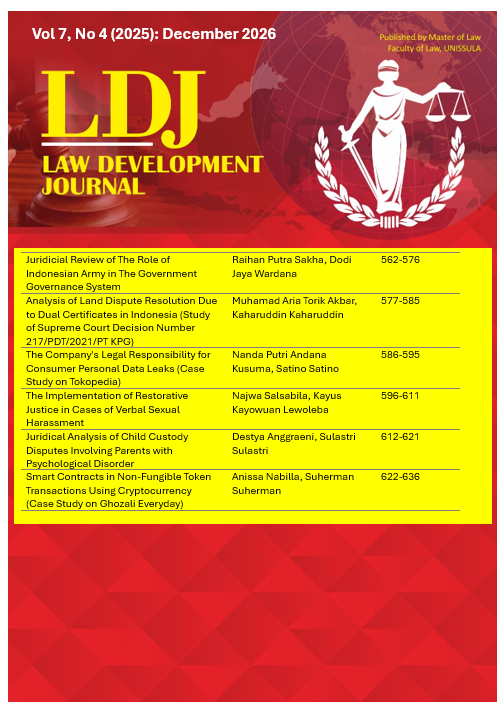
Smart Contracts in Non-Fungible Token Transactions Using Cryptocurrency (Case Study on Ghozali Everyday)
DOI:
https://doi.org/10.30659/ldj.7.4.622-636Keywords:
Cryptocurrency, NFT, Smart Contracts, Protection.Abstract
The development of blockchain technology has given rise to new innovations in the form of smart contracts, which are widely used in digital asset transactions, including Non-Fungible Tokens (NFTs). One case that highlights this phenomenon is Ghozali Everyday, where smart contracts play a crucial role in regulating the buying and selling of NFTs. However, the implementation of smart contracts in Indonesia faces legal challenges, particularly regarding the use of cryptocurrency as a payment instrument, which is still prohibited by Bank Indonesia regulations, even though electronic contracts are recognized as valid by the ITE Law. This study uses a normative juridical method with a legislative and conceptual approach. The analysis is conducted using Hans Kelsen's Hierarchy of Norms theory and Gustav Radbruch's Legal Validity theory to assess legal certainty, fairness, and utility in regulating smart contracts and cryptocurrencies in Indonesia. The results show a conflict of norms that creates legal uncertainty and limited legal protection for digital asset transaction actors. Therefore, regulatory updates are needed that are adaptive, consistent with the hierarchy of laws and regulations, and provide more comprehensive protection for consumers and businesses.
References
Books:
Alexander Sugiharto, S. H., Muhammad Yusuf Musa, M. B. A., & Mochamad James Falahuddin, S. T. (2022). NFT & Metaverse: Blockchain, Dunia Virtual & Regulasi . Indonesian Legal Study for Crypto Asset and Blockchain.
Sastrawidjaja, M. S. (2002). Perjanjian Baku Dalam Aktivitas Dunia Maya, Cyberlaw: Suatu Pengantar. Jakarta: Elips.
Journals:
Agustanti, R. D., Dirkareshza, R., Taupiqqurrahman, T., Fatahaya, S., & Wardoyo, R. A. (2021). Peningkatan Pengetahuan Praktik Jual Beli Online Berdasarkan Undang-Undang Informasi Dan Transaksi Elektronik Pada Masa Pandemi COVID-19. JMM (Jurnal Masyarakat Mandiri), 5(5), 2824-2837.
Danendra, D. (2023). Keabsahan Perjanjian Jual Beli Crypto Aset Menggunakan Smart Contract. Doctoral dissertation, Universitas Islam Indonesia.
Indrajit, R. E. (2020). Smart Contract: Fenomena, Peluang dan Tantangannya dalam Konsistensi Perkembangan Konvergensi Teknologi 4.0. Materi Webinar Fakultas Hukum Atma Jaya Yogyakarta, 2 Maret 2022.
Lie, C., Clarosa, V., Yonatan, Y. A., & Hadiati, M. (2023). Pengenalan Hukum Kontrak dalam Hukum Perdata Indonesia. Jurnal Kewarganegaraan, 7(1), 918–924.
Murizqy, M. A., & Dirkareshza, R. (2022). Peninjauan Aspek Keamanan Dan Perlindungan Hukum Terhadap Investor Crpytocurrency. Jurnal Ius Constituendum, 7(2), 277-292.
Szabo, N. (1996). Smart contracts: Building blocks for digital markets. Extropy: The Journal of Transhumanist Thought, (16), 18(2), 28.
Sulistianingsih, D., & Kinanti, A. K. (2022). Hak Karya Cipta Non-Fungible Token (NFT) Dalam Sudut Pandang Hukum Hak Kekayaan Intelektual. Krtha Bhayangkara, 16(1).
Tumangkar, T. (2016). Keabsahan Kontrak dalam Transaksi Komersial Elektronik. Jurnal Ilmiah Hukum dan Dinamika Masyarakat, 10(1).
Website:
BBC. (n.d.). Foto Selfie Ghozali di OpenSea Laku Miliaran Rupiah dengan Mata Uang Kripto, Apa Itu NFT dan Mengapa Bernilai Mahal? BBC News Indonesia. https://www.bbc.com/indonesia/majalah-59976296
CNN Indonesia. (2022). Kasus Ghozali Everyday. CNNIndonesia.com. https://www.cnnindonesia.com/
Kompas. (2022). Apa Itu NFT? Kompas.com. https://www.kompas.com/
Kompas. (2022). Mengenal Apa Itu NFT yang Baru-baru Ini Ramai Dibicarakan Publik. Kompas.com. https://www.kompas.com/tren/read/2022/01/13/193000765/mengenal-apa-itu-nft-yang-baru-baru-ini-ramai-dibicarakan-publik?page=all
Liputan6. (2022). Fenomena NFT Ghozali Everyday. Liputan6.com. https://www.liputan6.com/
Regulation:
Civil Code (BW).
Law Number 11 of 2008 concerning Electronic Information and Transactions.
Law Number 19 of 2016 concerning Amendments to Law Number 11 of 2008 concerning Electronic Information and Transactions (ITE).
Law Number 7 of 2011 concerning Currency.
Law Number 12 of 2011 concerning the Establishment of Legislation.
Law Number 8 of 1999 concerning Consumer Protection.
Law Number 21 of 2011 concerning the Financial Services Authority.
Law Number 4 of 2023 concerning the Development and Strengthening of the Financial Sector (PPSK Law).
Bank Indonesia Regulation Number 18/40/PBI/2016 concerning the Prohibition of the Use of Virtual Currency as a Means of Payment.
Bank Indonesia Regulation Number 23/6/PBI/2021 concerning the Implementation of Payment System Infrastructure.
Bappebti Regulation Number 5 of 2019 concerning Technical Provisions for the Implementation of Physical Crypto Asset Markets.
Bappebti Regulation Number 8 of 2021 concerning Guidelines for the Implementation of Physical Crypto Asset Markets on Futures Exchanges
Downloads
Published
Issue
Section
License
Authors who publish with this journal agree to the following terms:
- The journal holds the copyright for each article published with work licensed simultaneously under Creative Commons Attribution 4.0 International License, which allows others to share the work with an acknowledgment of the authorship and early publication of the work in this journal.
- Authors must agree to the copyright transfer agreement by checking the Copyright Notice column at the initial stage when submitting the article.
- The copyright of this document is owned by Journal Master of Law UNISSULA and is protected by law