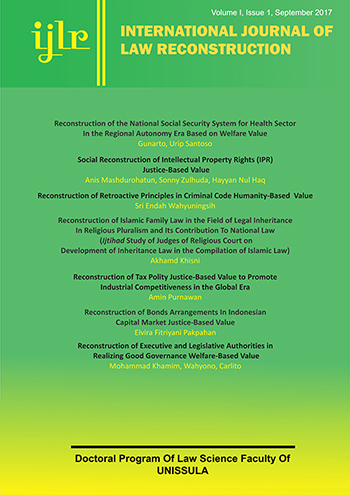
RECONSTRUCTION OF EXECUTIVE AND LEGISLATIVE AUTHORITIES TO MAKE A GOOD GOVERNANCE BASED ON WELFARE VALUES
DOI:
https://doi.org/10.26532/ijlr.v1i1.2411Abstrak
The executive and legislative powers of good governance based on welfare values imply that the executive and legislative bodies as the state organizers and the bearers of the mandate to manage public affairs should prioritize the general interests and safeguard the public good over many individual and group interests. The executive and legislative authorities in realizing good governance have not worked well due to the practice of extraterrestrial partnership relations, especially in terms of APBD (Regional Budget) arrangements that seem to promote personal or group interests. The role of function is large enough to cause conflict between the executive and legislative (local government), especially the head of the region.
Referensi
B.N. Marbun, DPRD Pertumbuhan, Masalah dan Masa Depannya, Ghalia Indonesia, Jakarta, 1983.
Bagir Manan, Menyongsong Fajar Otonomi Daerah, PSH Fak. Hukum UII, Yogyakarta, 2001.
Bambang Yudoyono, Kajian Awal Birokrasi Pemerintahan dan Politik Orde Baru, Tasrif Watampone, Jakarta, 2001.
C.F Strong, Modern Political Constitution: An Introduction To The Comparative Study Of History And Exising From, Sidwick And Jackson, London, 1975.
http://www.parliament.uk/factsheets, Undang-Undang Susduk: Pintu Masuk Penguatan Lembaga Perwakilan.
Unduhan
Diterbitkan
Terbitan
Bagian
Lisensi
Authors who publish with this journal agree to the following terms:
- Authors retain copyright and grant the journal right of first publication with the work simultaneously licensed under a Creative Commons Attribution License that allows others to share the work with an acknowledgement of the work's authorship and initial publication in this journal.
- Authors are able to enter into separate, additional contractual arrangements for the non-exclusive distribution of the journal's published version of the work (e.g., post it to an institutional repository or publish it in a book), with an acknowledgement of its initial publication in this journal.
- Authors are permitted and encouraged to post their work online (e.g., in institutional repositories or on their website) prior to and during the submission process, as it can lead to productive exchanges, as well as earlier and greater citation of published work (See The Effect of Open Access).

