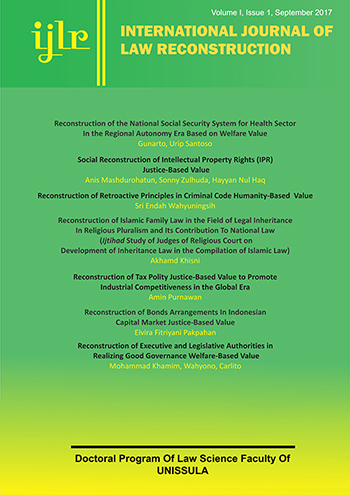
Reconstruction of the retroactive principle in the Indonesian criminal Law code based on the value of religious wisdom
DOI:
https://doi.org/10.26532/ijlr.v1i1.2310Abstrak
Indonesian Criminal Code that comes from Dutch heritage has to be reconstructed, because it is not in accordance with the state of Indonesia which is now already independent. One of the important principles in the Criminal Code that needs to be reconstructed is the retroactive principle contained in Article 1 paragraph (2) of the Criminal Code. The law can be retroactive as long as it benefits the defendant, not until the convicted person. The purpose of this research is to evaluate retroactive principle in Criminal Code seen from perspective value of religious wisdom, and ideal reconstruction of retroactive principle in next Criminal Code in accordance with perspective value of religious wisdom. Approach method in this research was done with normative juridical, the data used were secondary data by doing the extracting data bibliography, and data analysis were done by using qualitative descriptive method. Based on the values of religious wisdom, especially from the perspective of Islamic law in the case of any change of laws and regulations, in principle, non-retroactive principle (non-retroactive) is applied, but in certain cases the principle can be disregarded in accordance with the principles of "dlarar" and " maslahat ". The ideal reconstruction of the retroactive principle in the case of a change of laws and regulations after an act has occurred, new laws and regulations shall be applied in accordance with prevailing laws and regulations in favor of the producer and to the benefit of the public for certain offenses determined by Constitution.
Referensi
Abdurrahman I. Doi, Shari 'ah The Islamic Law, Tindak Pidana Dalam Syari 'at Islam, Penerjemah Wadi Mustari dan Basri Iba Asghari, Rineka Cipta, Jakarta, 1992.
Abdul Qadir Audah, Ensiklopedi Hukum Pidana Islam, Judul Asli At-Tasyri’al-Jina’i al-Islamy Muqaranan bil Qanunil Wad’iy, PT.Kharisma Ilmu, Bogor, Jilid II, 2007.
Barda Nawawi Arief, Perkembangan Asas-Asas HukumPidana Dalam Konsep KUHP (Perspektif Perbandingan Hukum Pidana), Pustaka Magister, Semarang, UNDIP, Semarang, 2007.
Ensiklopedi Hukum Pidana Islam, Jilid I-V, PT.Kharisma Ilmu, Jakarta, 2007.
Ensiklopedia Hukum Islam, Jilid I-VI, Ichtiar Baru Van Hoeve, Jakarta, 1997.
Jan Remmelink, Hukum Pidana Komentar Atas Pasal-Pasal Terpenting dari KUHP Belanda dan Padanannya dalam KUHP Indonesia, PT.Gramedia Pustaka utama, Jakarta, 2003.
Nyoman Serikat Putra Jaya, Beberapa Pemikiran Ke Arah Pengembangan Hukum Pidana, PT Citra Aditya Bakti, Bandung, 2008.
Romli Atmasasmita, Perbandingan Hukum Pidana, CV. Mandar Maju, Bandung, 2000
--------------, Perbandingan Hukum Pidana Kontemporer, Fikahati Aneska, Jakarta, 2009
-------------, Penerapan Hukum Pidana dan Asas Non-Retroaktif dalam Pemberantasan Korupsi, Sumber: http://www.transparansi.or.id, dan http://www.transparansi.or.id/berita/berita-maret2005/berita2_310305.html <http://jodisantoso.blogspot.com/2007/09/penerapan-hukum-pidana-dan-asas-non.html> Diunduh pada 2 juli 2016 pukul 20:08 WIB
Teungku Muhammad Hasby Ash-Shiddieqy, Pidana Mati Dalam Syari’at Islam, Pustaka Rizki Putra, Semarang , 1997.
----------------, Falsafah Hukum Islam, Pustaka Rizki Putra, Semarang, 1997.
Universal Islamic Declaration of Human Right
Unduhan
Diterbitkan
Terbitan
Bagian
Lisensi
Authors who publish with this journal agree to the following terms:
- Authors retain copyright and grant the journal right of first publication with the work simultaneously licensed under a Creative Commons Attribution License that allows others to share the work with an acknowledgement of the work's authorship and initial publication in this journal.
- Authors are able to enter into separate, additional contractual arrangements for the non-exclusive distribution of the journal's published version of the work (e.g., post it to an institutional repository or publish it in a book), with an acknowledgement of its initial publication in this journal.
- Authors are permitted and encouraged to post their work online (e.g., in institutional repositories or on their website) prior to and during the submission process, as it can lead to productive exchanges, as well as earlier and greater citation of published work (See The Effect of Open Access).

