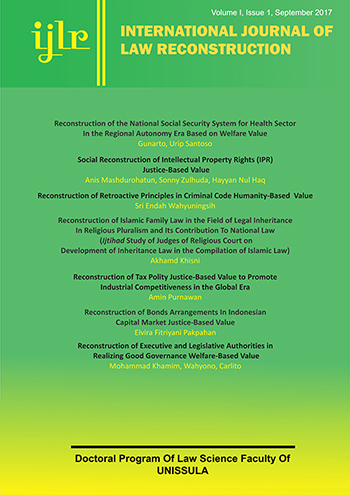
Taxing Policy Reconstruction Based on Justice Value to Encourage Industrial Competitiveness in the Global Era
DOI:
https://doi.org/10.26532/ijlr.v1i1.2258Abstract
The study of trading will not be separated from the study of industry and investment, they have the close relationship of these three things in determining the competitiveness of a country, especially in the current pattern of global value chain (GVC) trading. The aims of this study are: (a) to analyze the urgency of increasing the competitiveness of national industry in the era of world free trade, and (b) to reconstruct taxation policies to promote industrial competitiveness in the global era. Tax reform should be able to improve competitiveness, and enthusiasm to invest for the investors. Due to growing business will increase tax revenue. The tax policy is very influential on industry, trade, and investment, because according to business people, tax is the biggest investment constraint, besides security, law, labor, regional autonomy, and smuggling issue. The reconstruction of taxation policies through the updating of tax laws includes: simplifying administrative procedures, raising taxpayer awareness, implementing a credible, accountable and consistent self-assessment system, tariffing adjustments to improve competitiveness, and expanding tax bases to increase state revenues. In order to improve competitiveness with other countries, it is necessary to put forward the principles of fairness and neutrality in tariff setting, and provide incentives for small business development. The structure of the prevailing tax rate is simplified in stages, planned, differentiated tariffs, and simplified layers intended to provide a more proportional tax burden for each taxpayer class.
References
Amin Purnawan, 2011, “Rekonstruksi Sistem Pemungutan Pajak Penghasilan (PPh) Badan Berbasis Nilai Keadilan†dalam Jurnal Dinamika Hukum Terakreditasi, ISSN 1410-0797, Vol. 11 Edisi Khusus Februari.
Fidel, 2010, Cara Mudah & Praktis Memahami Masalah-Masalah Perpajakan Mulai dari Konsep Dasar sampai Aplikasi, Jakarta: RajaGrafindo Persada
Hunter, T. Wilard, 1968, The Tax Climate for Philanthropy, USA: Garamond/Pridemark Press Inc.
Joel Slemrod and Jon Bakija, 2008, Taxing Ourselves fourth edition a Citizen’s Guide to the Debate over Taxes, London: The MIT Press Cambridge.
Kementerian Perdagangan Republik Indonesia, 2011, Kajian Dampak Kesepakatan Perdagangan Bebas terhadap Daya Saing Produk Manufaktur Indonesia, Jakarta
Masagus M. Ridhwan dkk, 2015, Analisis Daya Saing dan Strategi Industri Nasional di Era Masyarakat Ekonomi ASEAN dan Perdagangan Bebas, Working Paper, Jakarta
Miyasto, 1997, Sistem Perpajakan Nasional dalam Era Ekonomi Global, Pidato Pengukuhan Guru Besar FE Undip, Semarang
Paul-Heinz Koesters, 1988, Tokoh-tokoh Ekonomi Mengubah Dunia: Pemikiran-pemikiran yang Mempengaruhi Hidup Kita, Jakarta: PT Gramedia.
Reuven Avi-Yonah, 2004, Corporations, Society, and The State: A Defence of The Corporate Tax, Paper 04-006, John M. Olin Center For Law and Economics, University Of Michigan
Rochmat Soemitro, 1986, Asas dan Dasar Perpajakan, Jilid I, Bandung: Eresco
Syofrin Syofan, dan Ansyhar Hidayat, 2004, Hukum Pajak dan Permasalahannya, Bandung: Refika Aditama
Tri Budiono, 2003, “Pemusatan Otoritas Aparatur Perpajakan dan Kejahatan Pajakâ€, Jurnal Hukum, Vol. XV (3) Desember.
Downloads
Published
Issue
Section
License
Authors who publish with this journal agree to the following terms:
- Authors retain copyright and grant the journal right of first publication with the work simultaneously licensed under a Creative Commons Attribution License that allows others to share the work with an acknowledgement of the work's authorship and initial publication in this journal.
- Authors are able to enter into separate, additional contractual arrangements for the non-exclusive distribution of the journal's published version of the work (e.g., post it to an institutional repository or publish it in a book), with an acknowledgement of its initial publication in this journal.
- Authors are permitted and encouraged to post their work online (e.g., in institutional repositories or on their website) prior to and during the submission process, as it can lead to productive exchanges, as well as earlier and greater citation of published work (See The Effect of Open Access).

