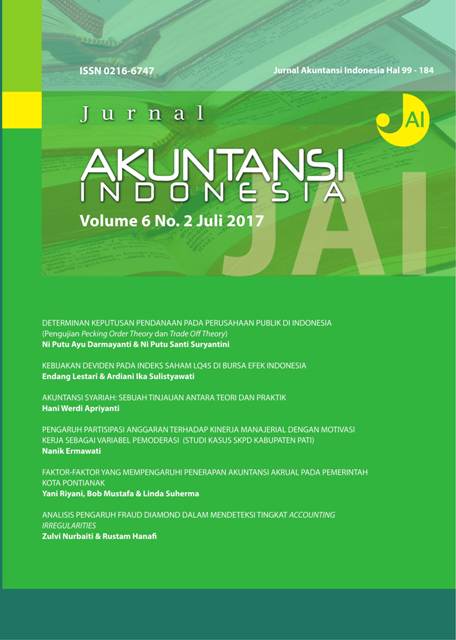
DETERMINAN KEPUTUSAN PENDANAAN PADA PERUSAHAAN PUBLIK DI INDONESIA (Pengujian Pecking Order Theory dan Trade Off Theory)
DOI:
https://doi.org/10.30659/jai.6.2.99-112Abstrak
Policy regarding capital structure involves a tradeoff between risk rate of return which the increase in debt can cause
an increased risk of the company, but on the other hand also increased the level of return expected by shareholders.
Less than optimal debt management can even lead to bankruptcy of the company. Previous studies conducted in
the Indonesian capital market find different results related to the effect of several variables that affect corporate
financing decisions. The results of empirical research to prove the existence of the application of the pecking order
theory (POT) and trade off theory (TOT) to firms in Indonesia. This study was conducted to examine again whether
variable dividend policy (proxied by the dividend payout ratio), profitability (proxied by return on assets), asset
structure (proxied by the composition of fixed assets), and the variability of the rate of profit (proxied by variablity
of EBIT) significantly against the funding decision (diprosikan to debt ratio) at public companies in Indonesia 2012-
2014. From the results of multiple linear regression analysis of the data 36 samples studied company, the conclusion
that the dividend policy and the structure of assets and a significant positive effect on financing decisions of public
companies in Indonesia 2012-2014. Profitability and variability of EBIT to the funding decisions in this study found
to be negative but not significant.
Keywords : debt ratio, pecking order theory, trade off theory
Unduhan
Diterbitkan
Terbitan
Bagian
Lisensi
Jurnal Akuntansi Indonesia is licensed under a Creative Commons Attribution-ShareAlike 4.0 International License 
License and Copyright Agreement
In submitting the manuscript to the journal, the authors certify that:
- They are authorized by their co-authors to enter into these arrangements.
- The work described has not been formally published before, except in the form of an abstract or as part of a published lecture, review, thesis, or overlay journal.
- That it is not under consideration for publication elsewhere,
- That its publication has been approved by all the author(s) and by the responsible authorities tacitly or explicitly of the institutes where the work has been carried out.
- They secure the right to reproduce any material that has already been published or copyrighted elsewhere.
- They agree to the following license and copyright agreement.
Copyright
Authors who publish with JAI agree to the following terms:
- Authors retain copyright and grant the journal right of first publication with the work simultaneously licensed under a Creative Commons Attribution License (CC BY-SA 4.0) that allows others to share the work with an acknowledgment of the work's authorship and initial publication in this journal.
- Authors are able to enter into separate, additional contractual arrangements for the non-exclusive distribution of the journal's published version of the work (e.g., post it to an institutional repository or publish it in a book), with an acknowledgment of its initial publication in this journal.
- Authors are permitted and encouraged to post their work online (e.g., in institutional repositories or on their website) prior to and during the submission process, as it can lead to productive exchanges, as well as earlier and greater citation of published work.








 ALLIANCE
