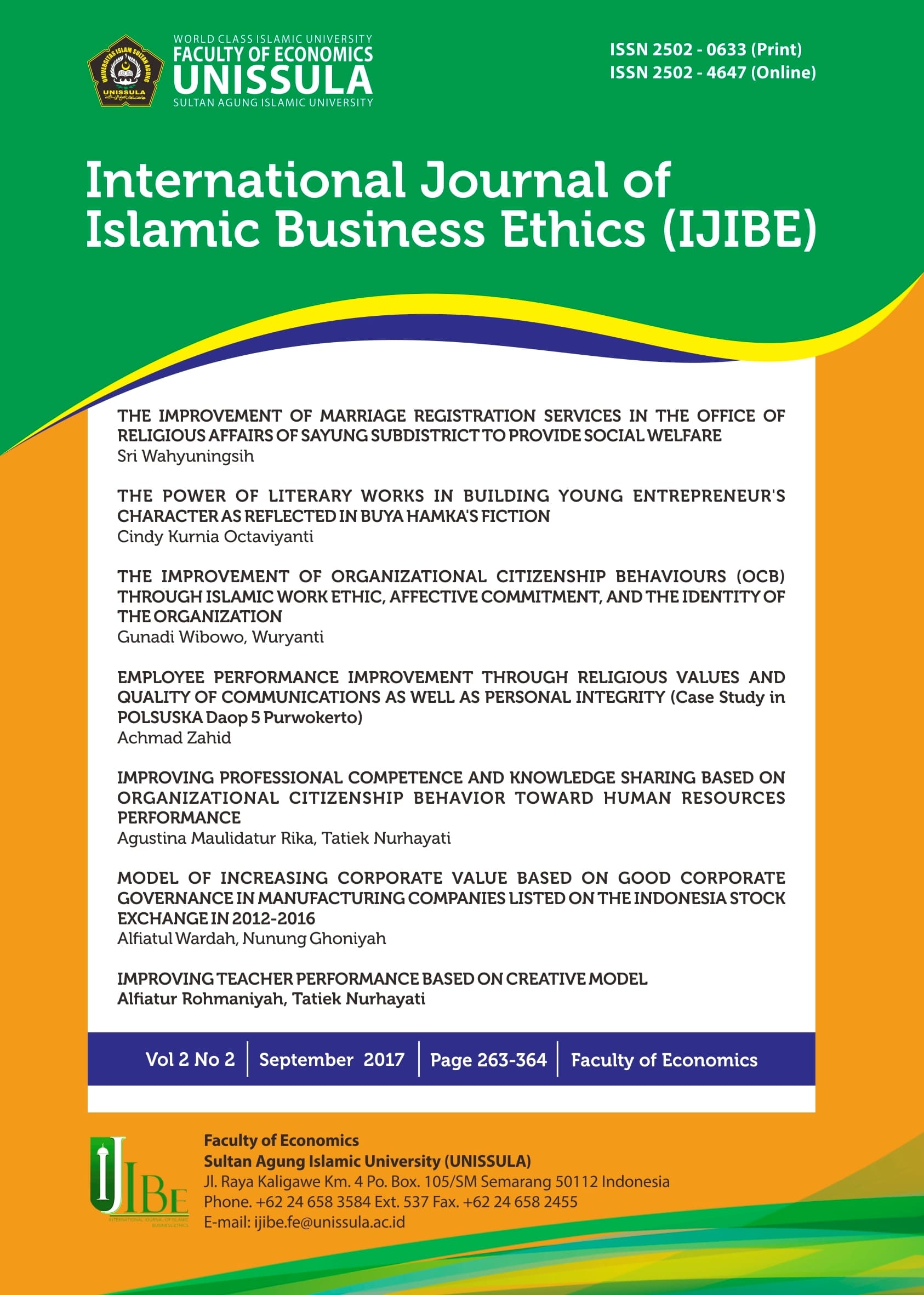
IMPROVING PROFESSIONAL COMPETENCE AND KNOWLEDGE SHARING BASED ON ORGANIZATIONAL CITIZENSHIP BEHAVIOR TOWARD HUMAN RESOURCES PERFORMANCE
DOI:
https://doi.org/10.30659/ijibe.2.2.314-331Abstract
This study aims to describe and analyze the effect of organizational citizenship behavior on HR performance with professional commitment and knowledge sharing as an intervening variable. The population used is the total number of employees of local water company (PDAM) Semarang total of them are 569 people, with a total sample of 85 people. The sampling technique is Proportional Random Sampling. The analysis tool is Partial Least Square. Another test result shows that OCB has a positive effect on professional competence. The test proves that OCB and professional competencies have a positive effect on knowledge sharing. Organizational citizenship behavior, professional competence and knowledge sharing have a positive effect on HR performance. The test results show that professional competence is able to be an intervening variable between OCB and knowledge sharing, while professional competence is not able to be an intervening variable between OCB and HR performance. Knowladge sharing is able to be an intervening variable between OCB and HR performance and knowledge sharing can also be an intervening variable between professional competence and HR performance.
Keywords: Organizational citizenship behavior, professional commitment and knowledge sharing and performance of Human Resources
Downloads
Published
Issue
Section
License
License and Copyright AgreementIn submitting the manuscript to the journal, the authors certify that:
- They are authorized by their co-authors to enter into these arrangements.
- The work described has not been formally published before, except in the form of an abstract or as part of a published lecture, review, thesis, or overlay journal.
- That it is not under consideration for publication elsewhere,
- That its publication has been approved by all the author(s) and by the responsible authorities – tacitly or explicitly – of the institutes where the work has been carried out.
- They secure the right to reproduce any material that has already been published or copyrighted elsewhere.
- They agree to the following license and copyright agreement.
Authors who publish with IJIBE agree to the following terms:
- Authors retain copyright and grant the journal right of first publication with the work simultaneously licensed under a Creative Commons Attribution License (CC BY-SA 4.0) that allows others to share the work with an acknowledgment of the work's authorship and initial publication in this journal.
- Authors are able to enter into separate, additional contractual arrangements for the non-exclusive distribution of the journal's published version of the work (e.g., post it to an institutional repository or publish it in a book), with an acknowledgment of its initial publication in this journal.
- Authors are permitted and encouraged to post their work online (e.g., in institutional repositories or on their website) prior to and during the submission process, as it can lead to productive exchanges, as well as earlier and greater citation of published work.
- Open Data Commons Attribution License, http://www.opendatacommons.org/licenses/by/1.0/ (default)
- Creative Commons CC-Zero Waiver, http://creativecommons.org/publicdomain/zero/1.0/
- Open Data Commons Public Domain Dedication and Licence, http://www.opendatacommons.org/licenses/pddl/1-0/
Open Data and Software Publishing and Sharing
The journal strives to maximize the replicability of the research published in it. Authors are thus required to share all data, code or protocols underlying the research reported in their articles. Exceptions are permitted but have to be justified in a written public statement accompanying the article.
Datasets and software should be deposited and permanently archived inappropriate, trusted, general, or domain-specific repositories (please consult http://service.re3data.org and/or software repositories such as GitHub, GitLab, Bioinformatics.org, or equivalent). The associated persistent identifiers (e.g. DOI, or others) of the dataset(s) must be included in the data or software resources section of the article. Reference(s) to datasets and software should also be included in the reference list of the article with DOIs (where available). Where no domain-specific data repository exists, authors should deposit their datasets in a general repository such as ZENODO, Dryad, Dataverse, or others.
Small data may also be published as data files or packages supplementary to a research article, however, the authors should prefer in all cases a deposition in data repositories.
This work is licensed under a Creative Commons Attribution 4.0 International License.


