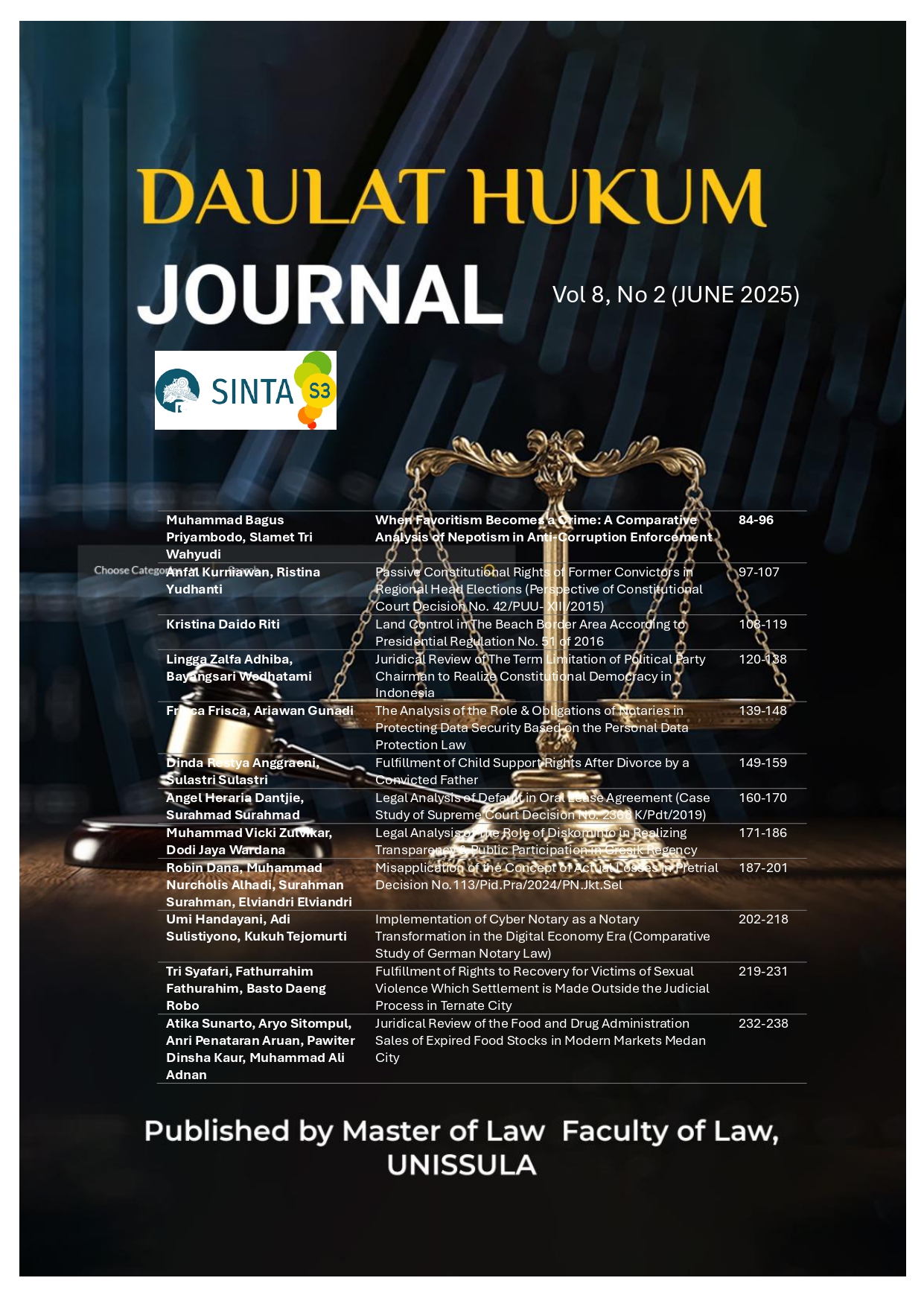
The Analysis of the Role & Obligations of Notaries in Protecting Data Security Based on the Personal Data Protection Law
DOI:
https://doi.org/10.30659/jdh.v8i2.45098Keywords:
Controller, Data, Notary, Obligations, Personal, Processing.Abstract
Notaries as public officials who are authorized to make authentic deeds carry out their duties and authorities inseparable from the processing of Personal Data, both physical and electronic. Notaries process Personal Data not only for Personal Data subjects, namely Clients, but also for workers or interns, or third parties whose information is provided by the Client. Since the enactment of the PDP Law, Notaries as officials who make authentic deeds in processing Personal Data are not only obliged to maintain the confidentiality of Personal Data, but there are also several other obligations regulated in the PDP Law as an effort to prevent and eradicate potential cybercrime. In this study, the author will dissect the role and obligations of Notaries in the security of Personal Data based on the PDP Law. The study used a normative legal method with a statutory approach and a conceptual approach. Through this study, it is concluded that a Notary as an official who makes authentic deeds has a crucial role, namely as a Personal Data Controller who can determine the purpose and method of processing personal data. Notaries have several obligations as regulated in the PDP Law, including having a basis for processing, ensuring the security of personal data, assessing the impact of Personal Data Protection, recording all personal data processing activities, appointing Personal Data Protection officials, fulfilling the rights of personal data subjects, and others. The ultimate goal of this study is expected to provide knowledge and legal certainty related to Personal Data Protection in notarial practice.References
Journals:
Matheus, Juan & Gunadi, Ariawan. (2024). Pembentukan Lembaga Pengawas Perlindungan Data Pribadi Di Era Ekonomi Digital: Kajian Perbandingan Dengan KPPU. Justisi: Vol. 10, No. 1: p.23. url: http://repository.untar.ac.id/id/eprint/42698
Mipon, Intan Permata & Putra, Mohamad Fajri Mekka. (2023). Penyelenggaraan Pelindungan Data Pribadi oleh Notaris berdasarkan Undang-Undang Nomor 27 Tahun 2022 tentang Pelindungan Data Pribadi. Jurnal Hukum & Pembangunan: Vol. 53 No. 3: p. 484. Doi: 10.21143/jhp.vol53.no3.1576, https://scholarhub.ui.ac.id/jhp/vol53/iss3/6/
Sisca, Katarina Arinda. (2024). Penegakan Hukum Notaris Yang Menggunakan Data Pribadi Orang Lain Dalam Akta: Perspektif Perlindungan Data. Jurnal Ilmiah Hukum Kenotariatan: Vol. 13 No. 1: p.98. Doi: 10.28946/rpt.v13i1.3764, http://journal.fh.unsri.ac.id/index.php/repertorium
Wicaksono, R. Budi Prabowo. (2023). Kewajiban Notaris Dalam Menjaga Data Pribadi Secara Digital Persepektif Undang-Undang Perlindungan Data Pribadi Indonesia. Otentik’s: Jurnal Hukum Kenotariatan: Vol. 5 No. 2: p.213. Doi: https://doi.org/10.35814/otentik.v5i2.5015
Books:
Budhijanto, Danrivanto. (2023). Hukum Pelindungan Data Pribadi di Indonesia Cyberlaw & Cybersecurity. Bandung: Refika Aditama.
Kristiawanto, H. (2024). Pengantar Mudah Memahami Metode Penelitian Hukum. Makassar: Nasmedia.
Rosadi, Sinta Dewi. (2023). Pembahasan UU Pelindungan Data Pribadi (UU RI No. 27 Tahun 2022). Jakarta: Sinar Grafika.
Suryanto. (2022). Metode Penelitian Hukum: Pengantar Penelitian Normatif, Empiris dan Gabungan. Gresik: Unigres Press.
Internet:
Kartika, Mimi. “Pemohon UU Perlindungan Data Pribadi Bandingkan Aturan Berbagai Negara”. Mahkamah Konstitusional Republik Indonesia. 12 November 2024, https://www.mkri.id/index.php?page=web.Berita&id=21834, accessed on 28 April 2025
Regulation:
The 1945 Constitution of the Republic of Indonesia.
Law Number 27 of 2022 concerning Protection of Personal Data.
Law Number 2 of 2014 concerning Amendments to Law Number 30 of 2004 concerning the Position of Notary.
Law Number 30 of 2004 concerning the Position of Notary.
General Data Protection Regulation.
Downloads
Published
Issue
Section
License
Authors who publish with this journal agree to the following terms:
- The journal holds the copyright for each article published with work licensed simultaneously under a Creative Commons Attribution 4.0 International License, which allows others to share the work with an acknowledgment of the authorship and early publication of the work in this journal.
- Authors must agree to the copyright transfer agreement by checking the Copyright Notice column at the initial stage when submitting the article.
- The copyright of this document is owned by Journal Master of Law UNISSULA and is protected by law



