





The role of Wordwall to teach English vocabulary for students with Mild Intellectual Disabilities (MID)
Abstract
Students with mild intellectual disabilities (MID) face significant challenges in English vocabulary acquisition due to delayed language development, limited working memory, and short attention spans, and traditional teaching strategies were often ineffective. Despite the potential of gamified digital media, there was limited research exploring the role of tools like Wordwall in supporting vocabulary instruction specifically for these learners. Therefore, this study aimed to explore the role of Wordwall in supporting English vocabulary learning for students with MID. This research employed a qualitative case study design. Using purposive sampling, data were collected through triangulation (classroom observation and semi-structured interview with three students and the English teacher) in one special-needs class in Semarang. The data were analyzed using thematic analysis. The findings revealed that Wordwall facilitated students’ engagement and participation in vocabulary learning, supported vocabulary retention, active participation driven by Wordwall activities, practicality and flexibility of Wordwall perceived by teacher, and created a more interactive and enjoyable classroom environment for students with MID. This study contributed to inclusive digital pedagogy by showing how Wordwall as gamified tools can support vocabulary learning for students with MID.
Keywords
Full Text:
PDFDOI: http://dx.doi.org/10.30659/jamr.7.1.22-35
Refbacks
- There are currently no refbacks.
Copyright (c) Robi'atul A'dawiyah, Nur Ekaningsih
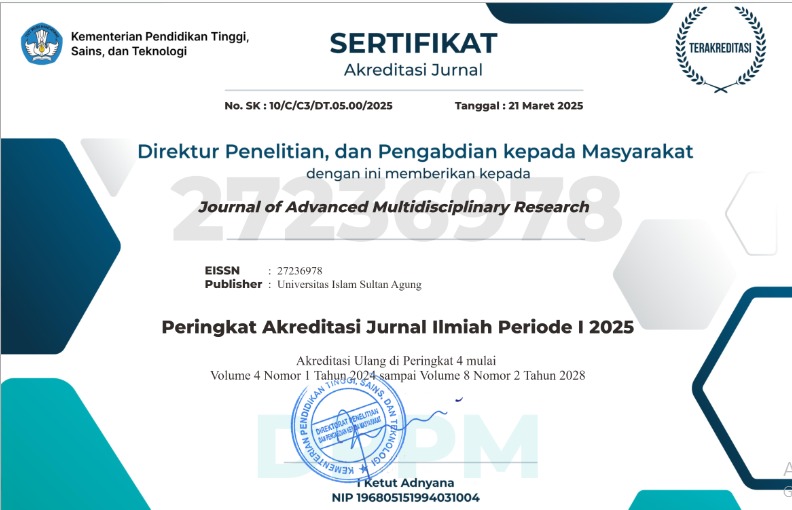
Journal of Advanced Multidisciplinary Research (JAMR) is published by Research and Community Service Department (LPPM) Universitas Islam Sultan Agung Semarang, Indonesia.
Address: Jl. Kaligawe Raya Km. 4 Semarang, Indonesia.